The Science of Learning: How The Next Step Tuition Uses Neuroscience-Informed Tutoring to Build Confidence and Better Results
Browse all categories
Discover how The Next Step Tuition uses neuroscience-informed tutoring, active recall, spaced practice, cognitive science and confidence-building techniques to help KS3, GCSE and A Level students learn more effectively.

What if tutoring was not simply about spending more time studying? What if students could be taught how to learn more effectively, remember information for longer, approach difficult questions with greater confidence and prepare their brains to retrieve knowledge when it really matters?
That question sits behind the developing teaching approach at The Next Step Tuition. Our tutoring approach draws on research from cognitive science, educational psychology and neuroscience-informed learning. Rather than relying only on traditional rereading, highlighting and repeated worksheets, we use evidence-based learning strategies including active recall, retrieval practice, spaced repetition, information chunking, interleaving, dual coding, worked examples, self-explanation and supportive feedback.
These techniques are particularly valuable for students preparing for KS3 assessments, GCSEs, A Levels, university applications and medical school interviews. The objective is simple: help students understand more, remember more, retrieve information more confidently and become increasingly independent learners.
What Is Neuroscience-Informed Tutoring?
Neuroscience-informed tutoring does not mean attaching brain scans to a lesson or claiming that a particular exercise magically rewires the brain. Good learning science is much more practical. It studies how attention, working memory, long-term memory, retrieval and previous knowledge affect learning.
The Education Endowment Foundation describes cognitive science in education as including areas such as working memory, schema development, cognitive load, spaced learning, interleaving and retrieval practice. The Next Step Tuition uses these principles to help tutors think carefully about how information is presented, practised, recalled and revisited.
A student might understand something perfectly during a lesson. That does not automatically mean they will remember it three weeks later. Learning therefore needs another stage: making knowledge easier to retrieve in the future. This is where methods such as retrieval practice and spaced learning become extremely useful.
Active Recall: Teaching Students to Retrieve, Not Simply Reread
Imagine a student studying biology. One approach is to read the same page about photosynthesis five times. It feels productive because the words gradually become familiar. But familiarity is not the same as being able to recall the answer in an examination.
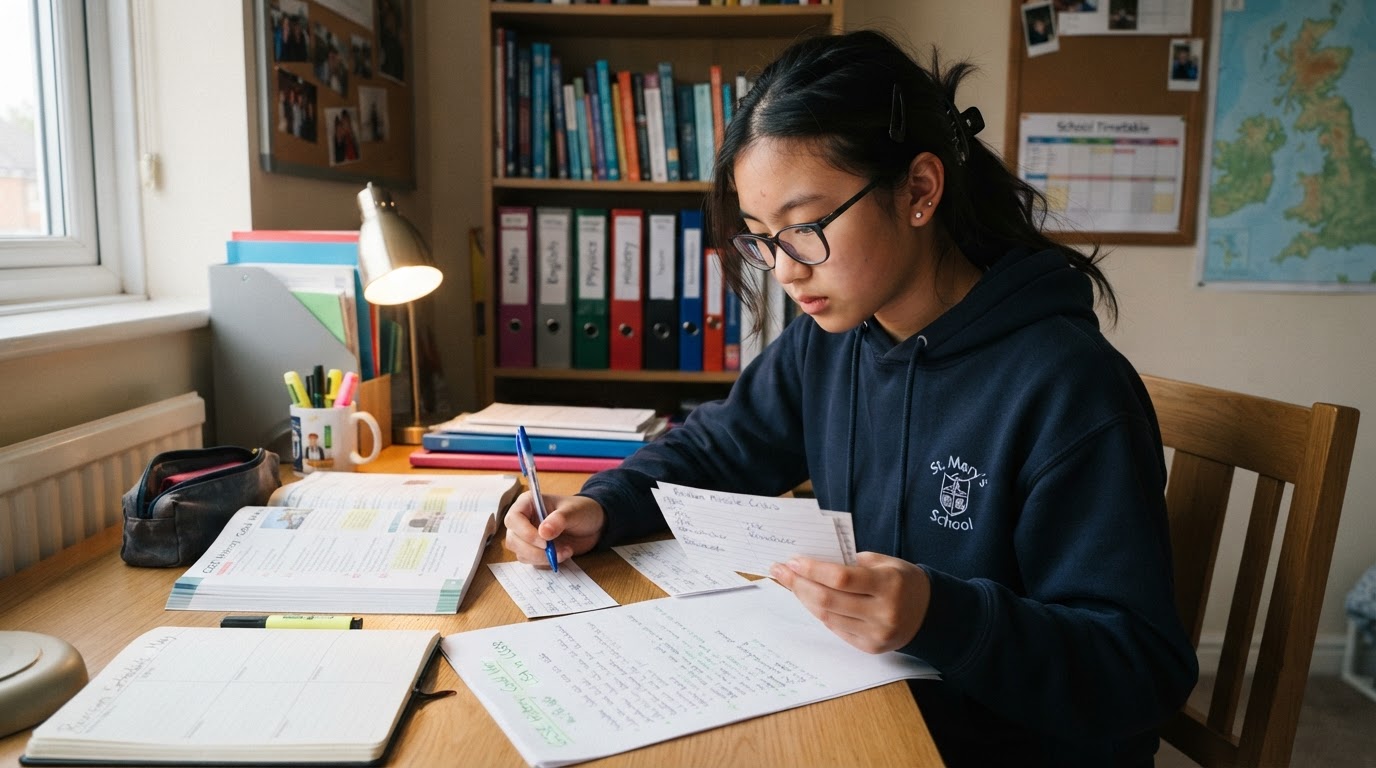
Active recall turns the process around. The student closes the book and attempts to answer questions from memory. What is photosynthesis? Where does it take place? What are the reactants? What are the products? Why is chlorophyll important? The student is now retrieving information rather than simply recognising it.
Research has repeatedly found that retrieval practice can improve long-term retention compared with simply studying material again. In a well-known study by Roediger and Karpicke, testing previously learned material improved later retention. A major review of learning techniques also rated practice testing as a high-utility learning strategy across different learners and educational situations.
At The Next Step Tuition, this means tutors can regularly ask students to explain ideas without looking at their notes. Getting something wrong is not treated as failure. It tells the tutor exactly where learning needs strengthening.
Spaced Repetition: Revisiting Knowledge Before It Disappears

Students often revise using what might be called the Sunday night method. They study one topic intensively for several hours and then barely touch it again. It may work until Monday morning. It is much less reliable several months later.
Spacing takes another approach. Important knowledge is revisited across different lessons and revision periods. Research into distributed practice has examined hundreds of experiments and consistently found advantages from spacing learning episodes rather than concentrating everything into one session.
The Next Step Tuition can therefore bring previous material back into later sessions. A chemistry student learning bonding this week might encounter a few bonding questions again next week, then later in a mixed chemistry exercise. The aim is not pointless repetition. It is planned retrieval over time. For GCSE and A Level students, this is particularly useful because examinations require knowledge from many months, and sometimes years, of study.
Chunking: Making Difficult Subjects Feel Manageable

Working memory has limited capacity. When too many unfamiliar ideas arrive at once, students can become confused even when they are perfectly capable of understanding the subject. The Education Endowment Foundation highlights the importance of cognitive load and warns that working memory can become overloaded when information or its presentation becomes unnecessarily complicated.
At The Next Step Tuition, difficult material can therefore be broken into smaller logical stages. Instead of learn electromagnetic induction, a tutor might divide it into: what a magnetic field is, what happens when a conductor moves through that field, how voltage is induced, and how this applies to generators. Each section becomes a small achievable step. Once those pieces are understood, they can be connected.
This is especially helpful when a student says I just do not get this topic. Very often the whole topic is not the problem. One missing piece is. Good tutoring finds that missing piece.
Building Schemas: Connecting New Knowledge to What Students Already Know
Learning becomes easier when new information can be attached to existing knowledge. Education researchers often describe these organised networks of knowledge as schemas. Consider an A Level biology student learning about respiration. Understanding glycolysis, the Krebs cycle and oxidative phosphorylation is much easier if the student already has secure knowledge of cells, enzymes, ATP and mitochondria.
A tutor therefore needs to ask: what does this student already know that we can connect this new idea to? This approach helps students stop seeing every chapter as a completely separate mountain to climb. Knowledge begins forming a connected map. That becomes increasingly important at A Level, where examination questions often require students to combine several ideas rather than repeat one memorised fact.
Interleaving: Learning to Recognise Which Knowledge to Use
Students sometimes practise twenty nearly identical questions in a row. By question five, they know what method is expected because every question uses the same technique. Real examinations are different. The paper does not normally tell the student to use the equation you practised yesterday. The student must identify the problem and select the right method.
Interleaving helps develop this skill. Instead of practising one question type repeatedly, related topics can be mixed together. Research has found benefits from interleaved practice in mathematics and has suggested that part of its value comes from helping learners distinguish between different kinds of problems and choose appropriate strategies.
The same principle can be used across science and English. A GCSE science session might mix calculation questions, explanation questions, graph interpretation, experimental design and previous topics. In English, students might move between identifying techniques, analysing quotations, explaining writer intention and constructing an examination paragraph. The learner has to think. And that is exactly the point.
Dual Coding: Words Plus Useful Visuals
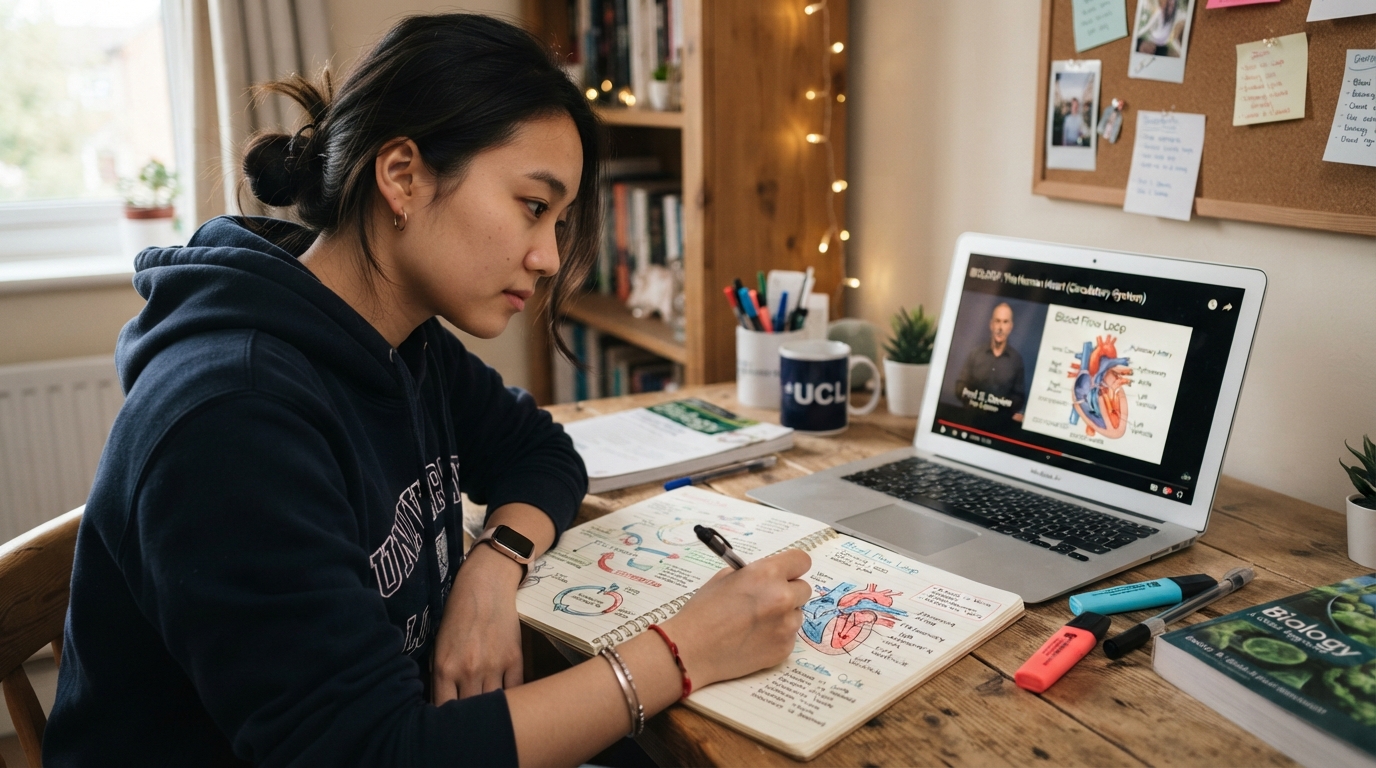
Some information is easier to understand when words and appropriate visuals work together. A tutor explaining the heart may combine a verbal explanation with a simple labelled diagram. A physics tutor might draw a force diagram. A chemistry tutor might illustrate particle movement. An English tutor might map relationships between characters, themes and quotations.
The important word is useful. A colourful diagram that distracts the learner is not automatically better than a simple one. Cognitive science research emphasises managing cognitive load and using visual information carefully rather than overwhelming learners with unnecessary material. The Next Step Tuition therefore aims to use visual information to make thinking clearer, not simply make worksheets prettier.
The Generation Effect: Let Students Think Before Giving Them the Answer
Tutoring should not become a tutor performing brilliantly while the student watches. The person who needs to do most of the thinking is the learner. One useful technique is asking the student to attempt an explanation before being given the complete answer.
Research into the generation effect has found memory advantages for information people generate themselves compared with information they simply read or receive. For example, before explaining diffusion, the tutor might ask: based on what you already know about particles, what do you think will happen? Even an incomplete answer creates something to work with. The tutor can then correct, refine and extend it. Learning becomes a conversation rather than a lecture.
Why Mistakes Can Be Valuable
Many students are frightened of getting answers wrong. That fear can make them reluctant to answer questions at all. A neuroscience-informed learning environment treats mistakes differently. A mistake made during tutoring is useful information. It shows exactly where the student's understanding needs attention.
Research on learning from errors indicates that attempting answers followed by corrective feedback can support learning. Feedback research also shows that feedback can have a meaningful effect on learning, although the type and quality of feedback matter. A Next Step tutor can therefore move away from simply saying wrong. Instead: you are close, your first step was correct, let us find where the reasoning changed. That small difference matters. Students learn that difficult questions are problems to investigate rather than threats to avoid.
Why Confidence Is Part of Academic Performance

Confidence should not mean telling every student that everything they do is brilliant. Students usually know when praise is empty. Real confidence is built through evidence. A student remembers something they previously forgot. They solve a question they previously could not start. They complete an examination section within the time. They explain an A Level concept without notes. They successfully answer a difficult follow-up question in a mock medical interview.
Those experiences build what psychologists call self-efficacy, the belief that you are capable of carrying out a particular task. Research has found relationships between academic self-efficacy and academic achievement. At the same time, test anxiety has been associated with poorer academic achievement, including in school-age students.
The aim at The Next Step Tuition is therefore earned confidence. Not I hope I can do it, but I have practised this and I know how to approach it. That is a very different feeling when an examination paper lands on the desk.
How These Methods Are Used for KS3 and GCSE Students
KS3 and GCSE learning provides the foundation for later study. Students may understand individual classroom lessons but struggle to connect everything when revision begins. Tutoring can use short retrieval questions at the beginning of lessons, small information chunks, worked examples, gradually reduced support, mixed-topic questions, diagrams and visual explanations, regular revisiting of previous material, student explanations and immediate corrective feedback.
Worked examples can be particularly useful when students are learning unfamiliar processes. The Education Endowment Foundation recommends making the tutor or teacher's thinking visible and gradually reducing scaffolding as learners become more confident. The objective is eventually for the student to solve the problem without the tutor. That is when tutoring has really worked.
Neuroscience-Informed A Level Tutoring
A Level study requires more than remembering facts. Students must analyse, compare, explain, apply and evaluate. The Next Step Tuition can therefore combine retrieval with deeper questioning. A chemistry tutor may ask why does increasing temperature change the rate of this reaction. A biology tutor might ask how would changing this variable affect the entire biological process. A physics tutor may ask which principle applies here, and why. An English tutor may ask how does this quotation support your interpretation, and what alternative interpretation could be made.
Students can also use self-explanation, sometimes described informally through methods such as the Feynman Technique. If a student can explain a difficult concept clearly in simple language, there is a good chance they understand it. If they cannot explain one stage, the tutor has found the gap.
English Tutoring: From Ideas to Structured Answers
English requires memory, interpretation, vocabulary, argument and organisation. A student can know a novel extremely well and still struggle to turn that knowledge into a high-quality answer. The Next Step Tuition can separate the process into manageable skills: remember relevant evidence, understand what the evidence means, connect it to the question, explain the writer's choices, develop an interpretation and organise the argument. Then practise retrieving and combining these skills under examination conditions.
This reduces the feeling that essay writing is one enormous mysterious task. It becomes a series of learnable decisions.
Personal Statements and University Applications
Large unstructured tasks often create procrastination. Write my university application feels enormous. A more manageable approach is: choose experiences, identify what was learned, select evidence, draft one section, review it, improve the wording and connect the sections. This reduces unnecessary cognitive load and allows the student to concentrate on the quality of each decision.
The Next Step Tuition helps students turn experiences into reflection rather than simply producing lists of achievements. Instead of I attended a course, the important question becomes: what did you learn from it, and how did it change your thinking? That is where a stronger application begins.
Medical Interview Preparation: Training Retrieval Under Pressure

Medical interviews create a different challenge. A candidate may know their material perfectly at home and suddenly struggle to answer when faced with a timer, unfamiliar interviewer and unexpected follow-up question. This is why preparation needs more than memorising model answers. Students need repeated opportunities to retrieve, organise and communicate ideas under realistic conditions.
Mock interviews can introduce timed stations, unfamiliar questions, professional interview language, ethical scenarios, follow-up questioning, reflection and immediate feedback. The purpose is not to teach robotic answers. It is to make structured thinking under pressure increasingly familiar.
Research shows that test anxiety can interfere with academic performance, and stress-management interventions have been studied as ways of reducing performance anxiety. Repeated realistic practice can therefore be combined with calm preparation and constructive feedback. The candidate begins to recognise: I have dealt with difficult questions before, I know how to structure my thinking. Again, confidence comes from preparation rather than wishful thinking.
What Might a Neuroscience-Informed Tutoring Session Look Like?
A session does not have to feel scientific. In fact, the student may barely notice the learning science behind it. A typical lesson might begin with five minutes of retrieval questions from previous topics. The tutor then identifies one area requiring attention. A new concept is broken into manageable pieces. The tutor demonstrates one example while explaining the thinking behind each step. The student completes another example with support. Support is gradually removed. The student then attempts questions independently. An older topic may be mixed back into the lesson. Near the end, the student explains the new concept without notes. The tutor identifies what should be revisited in a future lesson.
Simple. Structured. Evidence-informed.
Teaching Students How to Learn Without Their Tutor
The ultimate purpose of tutoring should not be permanent dependence on tutoring. Students need to develop their own learning strategies. This involves metacognition, which means thinking about and managing your own learning. The Education Endowment Foundation reports strong evidence supporting metacognition and self-regulated learning and notes that these approaches can be effective in one-to-one settings as well as classrooms.
Students can gradually learn to ask themselves: what do I actually know, what am I only recognising because the book is open, what can I explain without notes, where are my knowledge gaps, when should I revisit this topic, and what type of question keeps causing me difficulty. That is powerful because the student begins taking control.
The Next Step: Smarter Tutoring, Stronger Learners
There will never be one perfect learning technique for every student, every subject and every situation. Good tutoring still requires experience, judgement, patience and an understanding of the individual student. Science does not replace a good tutor. It helps a good tutor make better decisions.
That is the philosophy behind neuroscience-informed tutoring at The Next Step Tuition. We combine personal teaching with evidence-informed learning strategies to help students build knowledge, strengthen recall, understand difficult concepts and approach examinations, applications and interviews with greater confidence.
From KS3 through GCSE and A Level to university and medical school preparation, the goal remains the same: understand it, practise it, retrieve it, apply it, and believe you can do it because you have proved that you can.
Frequently Asked Questions About Neuroscience-Informed Tutoring
1. What is neuroscience-informed tutoring?
Neuroscience-informed tutoring uses reliable findings from learning science, cognitive psychology and relevant neuroscience research to improve how students learn. Techniques can include active recall, retrieval practice, spaced repetition, chunking, interleaving, worked examples, visual explanations and metacognition. The aim is not to use fashionable brain hacks, but to organise tutoring around what research tells us about attention, memory, practice and learning.
2. Does neuroscience-based tutoring improve exam results?
No tutoring method can guarantee a particular grade. However, several techniques used in neuroscience-informed tutoring, particularly retrieval practice and spaced practice, have strong research support for improving learning and long-term retention. Better recall, stronger understanding and effective examination practice can place students in a better position to demonstrate what they know.
3. What is active recall in tutoring?
Active recall means trying to remember information without immediately looking at the answer. A tutor might ask a student to explain photosynthesis, recall a quotation or describe a physics principle from memory. Research shows that retrieving information can strengthen later retention more effectively than repeated passive study.
4. What is spaced repetition for GCSE and A Level revision?
Spaced repetition means returning to important information after gaps rather than studying it once in one long session. A topic learned today might be retrieved again next week and then revisited later in mixed examination practice. Research into distributed practice supports spacing learning over time for longer-term retention.
5. Can neuroscience-informed tutoring help a student who lacks confidence?
It can support confidence by giving the student repeated evidence of progress. Instead of relying on reassurance alone, students practise recalling knowledge, solving problems and correcting mistakes. Over time, successful experiences can strengthen academic self-efficacy, which research has associated with academic performance.
6. How does The Next Step Tuition use neuroscience techniques for GCSE science?
GCSE science tutoring can combine retrieval questions, spaced revision, diagrams, worked examples, mixed-topic practice and student explanations. Complex subjects in biology, chemistry and physics can be divided into smaller steps before being connected again. This helps manage cognitive load while building knowledge that students can later retrieve and apply.
7. Are these learning techniques useful for A Level students?
Yes. A Level students need both strong knowledge and the ability to apply it. Retrieval practice helps secure knowledge, while techniques such as self-explanation, interleaving and deeper why and how questions can encourage students to connect ideas and identify gaps in understanding.
8. Can learning science help with university and medical school interviews?
Yes, particularly when preparation combines retrieval, structured responses, mock interviews and feedback. Students can practise answering unfamiliar questions under realistic time pressure so that organising thoughts and communicating clearly becomes more familiar. Preparation should develop flexible thinking rather than memorised scripts.
9. Why does The Next Step Tuition use short sections and chunking?
Working memory has limited capacity. Presenting too many unfamiliar ideas at once can make a subject unnecessarily difficult. Chunking breaks complex material into smaller connected stages so that students can understand each part before combining them into a larger idea.
10. What is different about The Next Step Tuition's tutoring approach?
The Next Step Tuition combines personal one-to-one teaching with evidence-informed learning methods. Tutors do more than explain an answer. Students are encouraged to retrieve knowledge, explain their thinking, identify mistakes, revisit earlier learning and gradually work more independently. The goal is not simply completing today's homework, but developing stronger learners for future examinations, university and beyond.
Want this kind of support for your child?
Book a free 60-minute trial session. We will diagnose where your child is now and show them exactly how to improve.
Book a Free Trial SessionBrowse all categories