
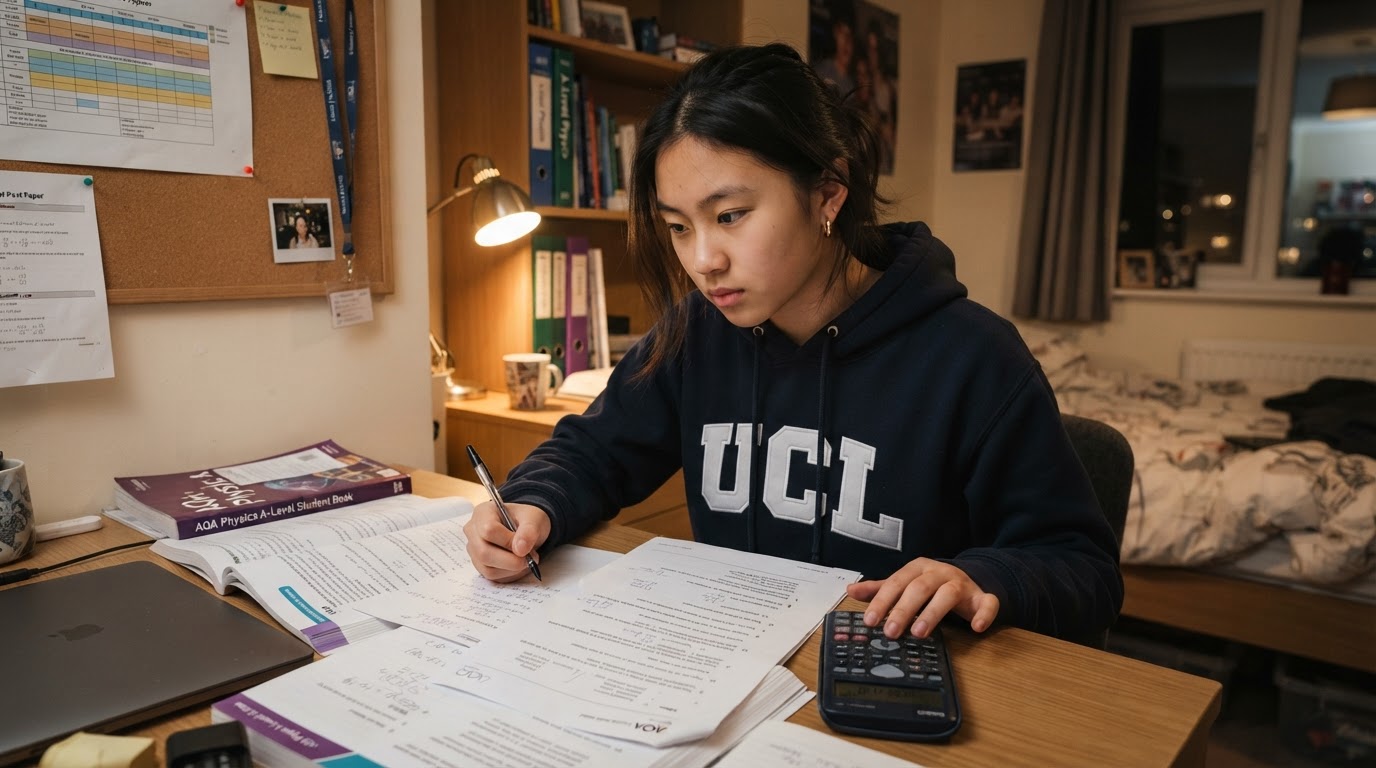
A-Level Exam Technique: The Missing Skill That Separates A from B Grades
Browse all categories
Why so many A-Level students know the content but lose marks on application questions — and the repeatable technique that closes the gap.
The A-Level Gap That Nobody Warns You About
If your child sailed through GCSEs and is now struggling at A-Level, they are in very good company. The jump between GCSE and A-Level is the single biggest step in secondary education. Not because the content is dramatically harder — though it is more detailed — but because the way marks are awarded changes fundamentally. At GCSE, knowing the content often earns most of the marks. At A-Level, knowing the content is the baseline. The marks that separate an A from a B are almost entirely about application, analysis and the precise language examiners expect.
I see this pattern constantly. A student understands photosynthesis perfectly, can explain the light-dependent reactions in detail, and then loses six marks on a question about a genetically modified crop because they did not link their knowledge to the specific context the question gave them. They did not lack knowledge. They lacked exam technique.
This article is about closing that gap. It is written for students who are working hard and not seeing the grades they are capable of, and for parents who want to understand why.
What A-Level Examiners Are Actually Looking For
A-Level mark schemes are structured around assessment objectives — AO1 (knowledge), AO2 (application) and AO3 (analysis and evaluation). Most students are strong at AO1. They have revised the content. The marks they lose are almost always in AO2 and AO3, which together often account for the majority of the paper.
AO2 application questions give you a novel context — a new experiment, an unfamiliar organism, a clinical scenario — and ask you to apply your knowledge to it. The key skill is not to panic at the unfamiliar context but to identify which part of your knowledge is relevant and then explicitly link it. Examiners are looking for connective language: "this is because," "as a result," "which means that." A student who writes accurate facts but does not link them to the context will not earn the application marks.
AO3 analysis and evaluation questions ask you to interpret data, weigh up evidence, or judge the validity of a method. Here, examiners reward structured thinking: identifying a trend, explaining it with data, and commenting on limitations. Many students lose marks by making vague statements like "the results are unreliable" without specifying which result, why, and what effect it has on the conclusion.
The Technique We Teach
In our tutoring sessions we do not just teach content. We teach a repeatable technique for every question type. For extended response questions, we use a simple framework: identify the command word, bullet-point the key points before writing, and structure the answer so each point links explicitly to the question context. We practise this on past paper questions until it becomes automatic.
For data questions, we teach students to describe the trend first, quantify it with data from the graph or table, and then explain it using their subject knowledge. For evaluation questions, we teach them to present both sides, weigh them, and reach a justified conclusion. These are not tricks — they are the thinking processes that the mark schemes are designed to reward.
The result is that students walk into the exam knowing exactly how to approach each question type. They are not relying on inspiration or memory of a similar question. They have a method. And a method, practised enough, becomes confidence.
Why Recorded Lessons Are Especially Valuable at A-Level
At A-Level, the depth of each topic means that a single explanation in a lesson is rarely enough. Students need to revisit concepts, especially the harder ones, multiple times. Because we record every lesson and share it with the student, they can rewatch the moment a difficult concept clicked. They can pause on a worked example the night before a mock. They can replay the breakdown of a mark scheme until the structure is second nature.
This is not a small thing. Many of our A-Level students tell us the recordings are the single most useful revision resource they have — more useful than their textbook, more useful than their class notes, because the recordings show the thinking process, not just the final answer.
Parents tell us the recordings give them confidence too. A-Level is a high-stakes time, and being able to see exactly what is covered in each session — the quality of the teaching, the engagement of their child, the progress being made — removes a great deal of anxiety.
Building Confidence Under Pressure
A-Level years are stressful. The stakes feel high, and students who are used to doing well can feel their identity threatened when grades dip. A big part of our role is not academic — it is emotional. We help students see that a dip is not a verdict on their ability. It is information. It tells us what to work on next.
We celebrate progress, not just results. A student who moves from a D to a C on a topic test has made real progress, even if their target is an A. We name that progress, we record it, and we remind them of it when the pressure builds. Confidence at A-Level is built from evidence — the evidence that the method works, that the work is paying off, and that they are not alone in this.
If your child is working hard at A-Level and not seeing the grades, we offer a free 60-minute trial session. We will look at a recent piece of their work, diagnose where the marks are being lost, and show them the technique that will close the gap. One session is often enough to change how a student feels about the subject — and about themselves.
Want this kind of support for your child?
Book a free 60-minute trial session. We will diagnose where your child is now and show them exactly how to improve.
Book a Free Trial SessionBrowse all categories