Why Highlighting Textbooks Fails GCSE Students (And What Works Instead)
Browse all categories
Discover why passive reading and highlighting create an illusion of competence, and how active recall flashcards double memory retention before mock exams.
The Illusion of Competence
If your child spends hours revising but their mock grades do not move, they are probably experiencing one of the most common traps in GCSE revision: the illusion of competence. It happens when a student reads through their notes, highlights key phrases, and feels a warm sense of familiarity. They believe they know the material. But when the exam question asks them to retrieve and apply that knowledge, their mind goes blank.
This is not a sign of low ability. It is a sign that the revision method is not matching what the exam actually demands. Reading and highlighting feel productive, but they are passive activities. They let information flow into the brain without ever asking the brain to pull it back out again. And retrieval — the act of recalling information from memory — is exactly what an exam requires.
The good news is that this is one of the easiest problems to fix. Once a student switches to active revision methods, progress is often rapid. In this article I will explain why passive revision fails, what the neuroscience tells us, and exactly how to build an active recall routine that works.
What the Neuroscience Says
Decades of cognitive psychology research, much of it summarised in the work of Roediger and Karpicke, shows that retrieval practice — testing yourself on material — produces far stronger long-term memory than re-reading or reviewing. In one landmark study, students who practised retrieval remembered around 50% more material a week later than students who simply re-studied the same content.
The reason is that every time you force your brain to retrieve a piece of information, you strengthen the neural pathway that holds it. It is like walking a path through a field: the more times you walk it, the clearer and easier it becomes. Re-reading, by contrast, is like looking at a map of the path without ever walking it. You recognise the route, but you cannot find it in the dark.
This is why we build every tutoring session around active recall. We do not just explain concepts and move on. We ask the student to explain them back to us, to apply them to new questions, and to retrieve them in the next session. This is also why we record every lesson — students can rewatch a concept, pause, and test themselves on what was covered before checking their answer against the recording.
How to Build an Active Recall Routine
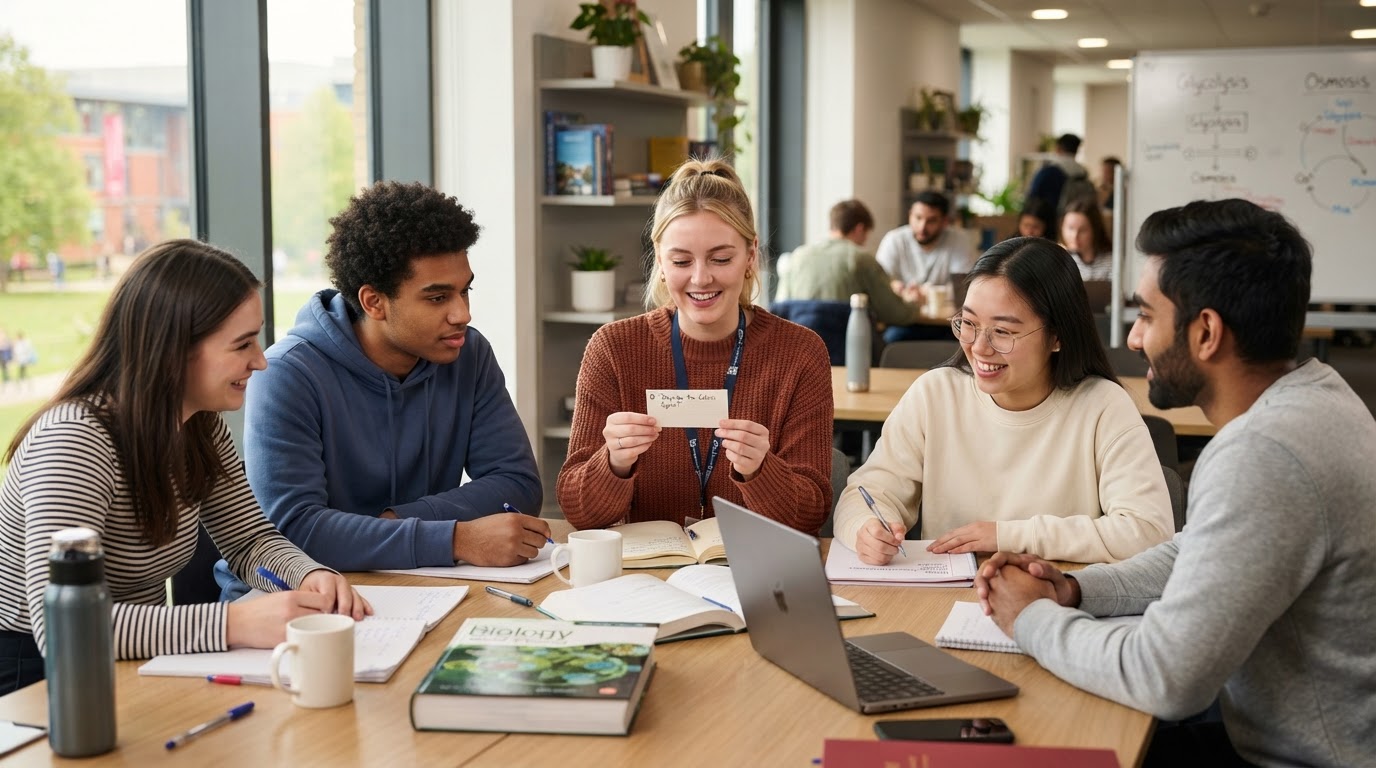
The most effective active recall tool for GCSE students is the flashcard — but not the way most students use them. A good flashcard does not simply have a definition on the back. It asks a question that forces the student to retrieve and, where possible, apply the concept. For example, instead of "Define osmosis," a better card asks, "Explain why a red blood cell bursts in pure water using the concept of osmosis." The first tests recall of a definition. The second tests understanding and application — which is what the exam rewards.
We help students build flashcard sets tailored to their exam board, organised by topic, and reviewed on a spaced repetition schedule. Spaced repetition means revisiting cards at increasing intervals — one day, three days, one week, two weeks — so that each review happens just as the memory is beginning to fade. This is the most efficient way to move information into long-term memory, and it is far more effective than cramming the night before.
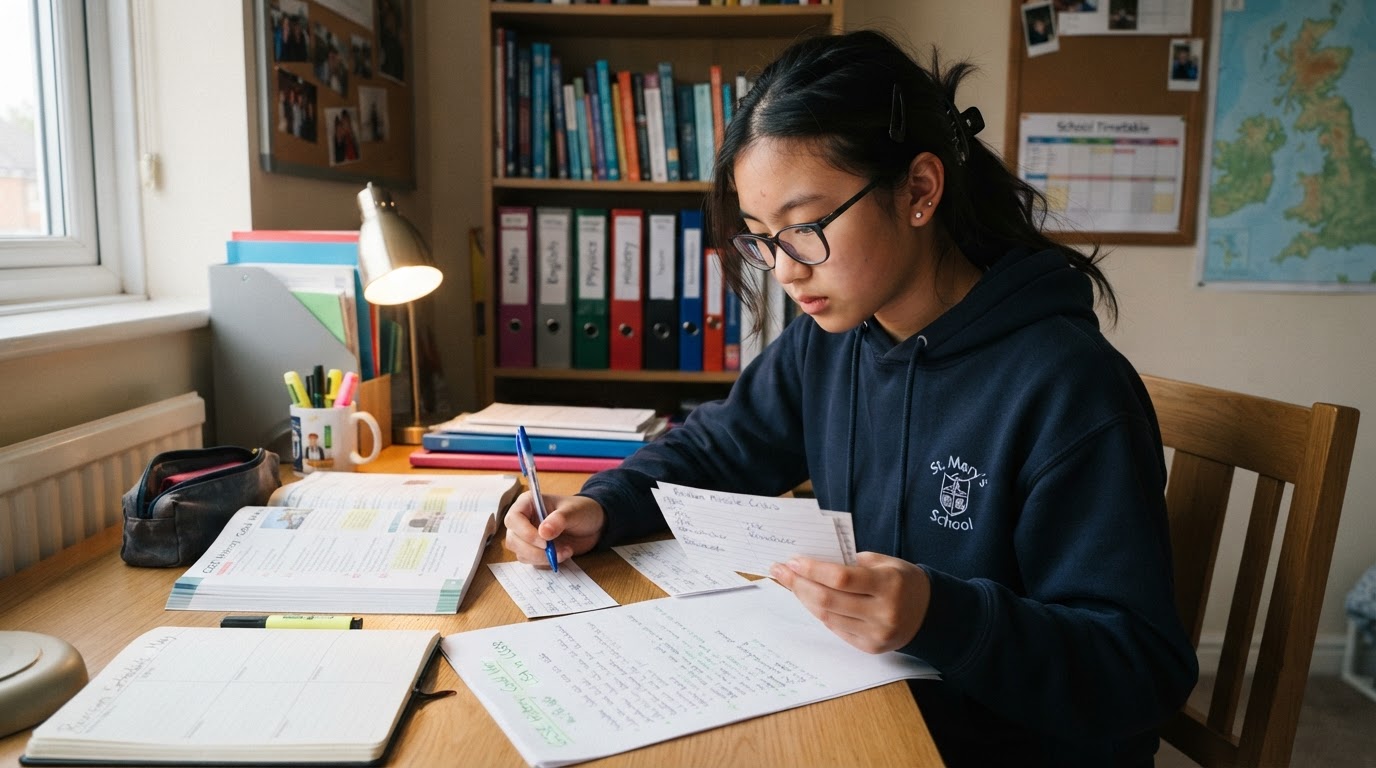
Another powerful technique is blurting. The student takes a blank page, writes the topic at the top, and writes down everything they can remember about it — no notes, no books. Then they open their notes and compare, highlighting in red anything they missed or got wrong. Those gaps become the focus of the next revision session. This is uncomfortable, which is exactly why it works.
Why Recorded Lessons Supercharge Revision
One of the most common things parents tell us is that their child does not know how to revise. They sit at their desk for hours but cannot account for the time. Recorded lessons solve this problem in a simple, powerful way.
Because every one of our sessions is video recorded and shared with the student, they have a personal revision library tailored exactly to what they have covered. Instead of staring at a textbook trying to understand a concept they half-remember from a lesson months ago, they can rewatch their own tutor explaining it clearly, pause at the exact moment they need to think, and test themselves on the worked example. This is active, targeted revision — not passive page-turning.
Parents also value the recordings because they can see exactly how lessons are run. They can judge the quality of the teaching for themselves and track their child's progress week by week. There is no guessing what happens in the session — it is all there to watch.
Building Confidence Through Evidence
The reason active recall builds confidence — not just grades — is that it gives students evidence of their own progress. When a student re-reads notes, they never really know what they know. When a student tests themselves and gets it right, they have proof. And when they get it wrong, they have a clear, specific thing to fix. This transforms revision from a vague, anxious activity into a structured, purposeful one.
Confidence in exams does not come from telling yourself you will be fine. It comes from knowing, with evidence, that you have retrieved this material before and succeeded. That is what we build, session by session, with every student we teach.
If your child is revising hard but not seeing the grades, it is almost certainly a method problem, not an ability problem. We offer a free 60-minute trial session where we will diagnose their current approach and show them exactly how to revise more effectively. One session is often enough to change how a student feels about revision entirely.
Want this kind of support for your child?
Book a free 60-minute trial session. We will diagnose where your child is now and show them exactly how to improve.
Book a Free Trial SessionBrowse all categories