
The Neuroscience of Spaced Repetition: Why Cramming Fails A-Level Students
Browse all categories
The forgetting curve explained, with a practical interval schedule you can start tonight to improve retention across every science subject.
Why Cramming Feels Like It Works (But Does Not)
Every student has crammed. You sit down the night before an exam, read through your notes for four hours, walk into the exam the next morning, and it goes well. You conclude that cramming works. But a week later, you have forgotten most of what you knew. A month later, it is gone entirely. This is the hidden failure of cramming: it produces short-term performance but not long-term learning.
For GCSEs, where exams are clustered, cramming can sometimes get a student through. For A-Levels, where the content is cumulative and the exams test understanding built over two years, cramming is a disaster. The student who crammed their way through Year 12 will find Year 13 impossible, because the foundations are not there. This article explains why, using the neuroscience of memory, and gives a practical alternative you can start tonight.
The Forgetting Curve
In the 1880s, the psychologist Hermann Ebbinghaus discovered that memory decays in a predictable pattern. Immediately after learning something, you remember it well. Within a day, you have forgotten more than half. Within a week, most of it is gone. This decay curve — the forgetting curve — is the enemy of every student.
But Ebbinghaus also discovered the antidote. Each time you review the material, the forgetting curve flattens. The memory becomes more stable and lasts longer before it begins to fade. After several well-spaced reviews, the memory is effectively permanent. This is the principle behind spaced repetition: reviewing material at increasing intervals so that each review happens just as the memory is about to fade, strengthening it before it is lost.
The neuroscience is clear. Every time a memory is retrieved, the synaptic connections that encode it are strengthened. The memory becomes easier to retrieve and more resistant to interference. Spaced repetition works because it forces retrieval at the optimal moment — not too soon, when the memory is still strong, and not too late, when it has already faded. This is not a study hack. It is how the brain actually works.
A Practical Spaced Repetition Schedule
The most common question students ask is: how long should the intervals be? The answer depends on the material and the student, but a simple, effective schedule looks like this. Review new material the day after you first learn it. Review it again three days later. Then a week later. Then two weeks later. Then a month later. By the fifth review, the material is in long-term memory.
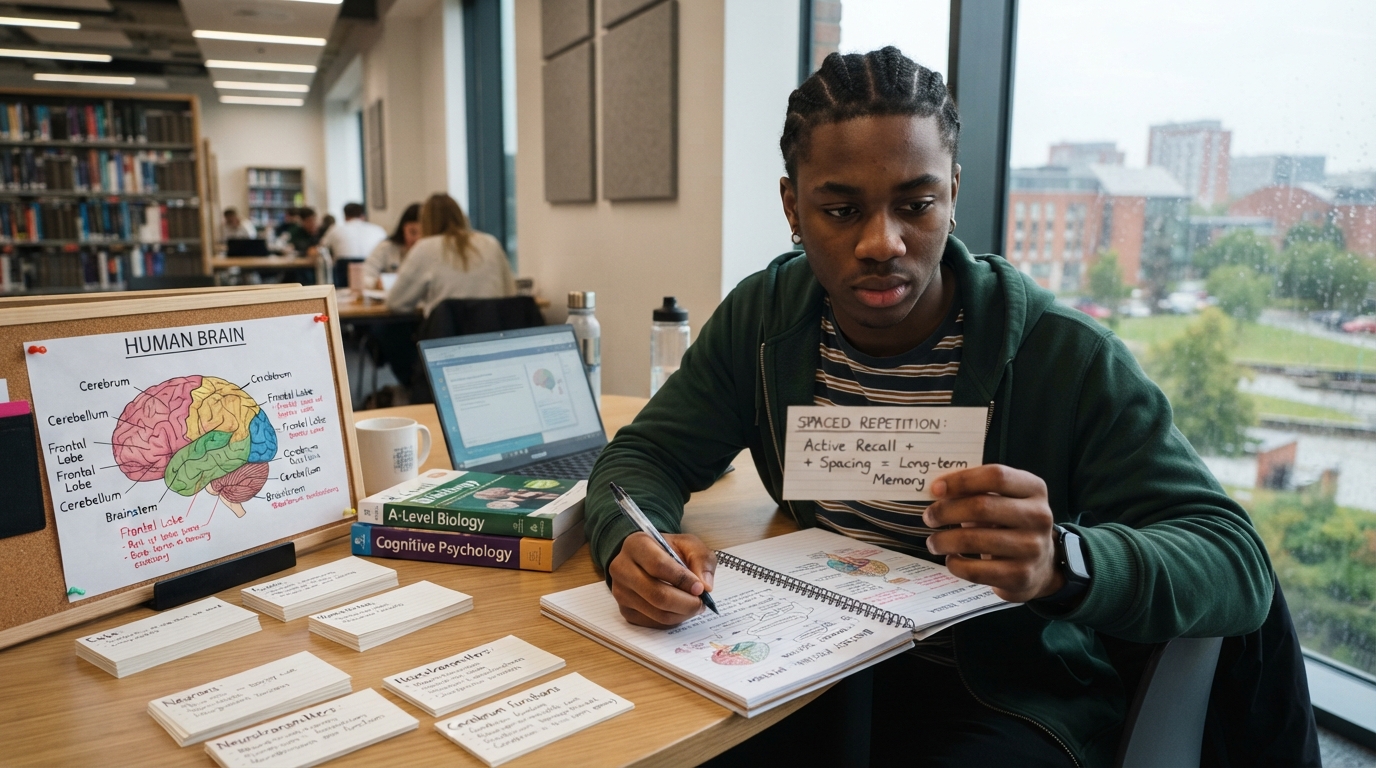
This schedule is easy to manage with flashcards. We help students build flashcard sets for each topic, organised by subject, and review them on this schedule. There are apps — Anki, Quizlet — that automate the scheduling, but a simple paper system works just as well. The key is consistency: a short review every day is far more effective than a long review once a week.
We build spaced repetition into every tutoring session. At the start of each lesson, we spend five minutes on active recall of material from previous sessions. This is not revision — it is retrieval, which is what strengthens memory. By the time a student sits their exam, they have reviewed every key concept multiple times, at the right intervals, and the material is firmly in long-term memory.
Why Recorded Lessons Make Spaced Repetition Easier
Spaced repetition requires the student to revisit material repeatedly. The problem most students face is that their notes are not a good tool for retrieval — they are a tool for reference. Reading notes is passive. What the student needs is a way to retrieve actively, and to check their retrieval against a reliable source.
This is where recorded lessons are transformative. Every one of our sessions is video recorded and shared with the student. They can use the recording as the answer key for their own retrieval practice. They attempt to recall a concept, then watch the relevant section of the recording to check. This is active, targeted and accurate — far more effective than re-reading notes, and far more efficient than searching a textbook.
Parents tell us the recordings give their child a structure for independent revision that they did not have before. Instead of staring at notes, unsure what to do, the student has a clear routine: retrieve, check against the recording, repeat on a schedule. This is how independent learning is built — not by leaving the student to figure it out, but by giving them a method that works.
Building Confidence Through Stable Memory
The reason spaced repetition builds confidence — not just grades — is that it gives students a stable foundation. A student who has crammed knows their memory is fragile. They feel the fragility in the exam. A student who has used spaced repetition knows their memory is solid. They have retrieved this material many times, over weeks. They trust it. That trust is the foundation of exam confidence.
Confidence is not a feeling you can manufacture. It is the result of evidence — the evidence that you have learned something securely, that you have retrieved it before and succeeded. Spaced repetition produces that evidence, session by session, card by card. By the time the exam arrives, the student is not hoping they remember. They know they remember, because they have tested themselves repeatedly and passed.
If your child is cramming and not retaining, we offer a free 60-minute trial session. We will look at how they currently revise, explain the neuroscience of spaced repetition, and set up a simple schedule they can start that evening. Cramming is a habit, and like any habit, it can be replaced — with one that actually works.
Want this kind of support for your child?
Book a free 60-minute trial session. We will diagnose where your child is now and show them exactly how to improve.
Book a Free Trial SessionBrowse all categories