
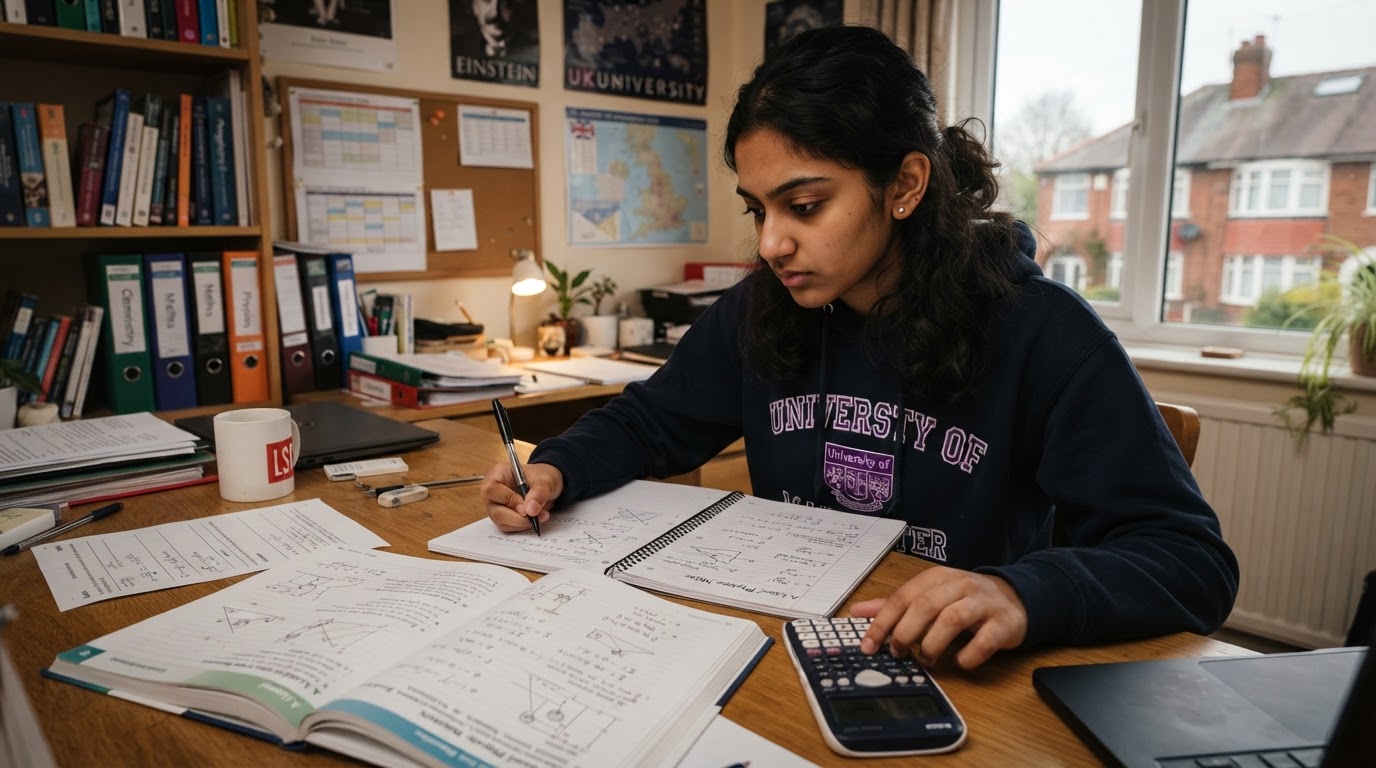
A-Level Physics Mechanics: The SUVAT Method That Never Fails
Browse all categories
A clear, repeatable method for tackling kinematics questions, with worked examples for projectile motion and multi-stage problems.
Why Mechanics Is the Gateway to A-Level Physics
Mechanics is the first major topic most A-Level Physics students meet, and it sets the tone for the whole course. For many students it is also the first time they are asked to combine maths and physics in a way that feels genuinely demanding. The equations are simple. Choosing the right one, in the right order, under exam pressure, is the challenge.
I have tuted many students who understand forces and motion conceptually but lose marks because their method is disorganised. They write down a formula, substitute numbers, and hope. When the question is unfamiliar — a projectile launched at an angle, a two-stage journey, a lift accelerating upward — the hope runs out and the marks with it.
This article is about the method we teach for kinematics questions. It is called the SUVAT method, and it is the single most reliable tool in A-Level Physics. Once it is automatic, mechanics questions stop being scary and start being straightforward. This is written for students who want a method they can trust and for parents who want to understand what good physics working looks like.
The SUVAT Method, Step by Step
SUVAT stands for the five variables of constant acceleration kinematics: s (displacement), u (initial velocity), v (final velocity), a (acceleration), and t (time). There are five equations, each relating four of these variables. The key insight is that every kinematics question gives you three of the five and asks for a fourth. Your job is to identify which three you know, which one you want, and pick the equation that contains all four.
Step one: list what you know. Write each known variable with its value and unit. If a value is not given but is implied — for example, an object starting from rest means u = 0 — state it explicitly. This step alone prevents a huge number of errors, because it forces the student to read the question carefully.
Step two: identify what you need to find. Write it down with its symbol. "Find t." This focuses the whole calculation.
Step three: choose the equation. Look at your list of knowns and the unknown. The correct equation is the one that contains the unknown and all three knowns, and does not contain the fifth variable. We teach students to write the equation down before substituting, so the structure is clear.
Step four: substitute and solve. Show every step. At A-Level, method marks are substantial, and a correct method with an arithmetic error will still earn most of the marks. A correct answer with no working shown may earn nothing if the examiner cannot follow the logic.
Step five: check the answer. Does a time of 0.02 seconds for a ball thrown across a room make sense? Probably not — a unit conversion has been missed. A quick sanity check catches most careless errors.
Handling Projectiles and Multi-Stage Problems
The SUVAT method extends cleanly to projectiles. The key is to treat horizontal and vertical motion separately. Horizontally, there is no acceleration (a = 0), so velocity is constant. Vertically, acceleration is g (9.81 m/s² downward). We teach students to draw a quick diagram, split the motion into horizontal and vertical, and apply SUVAT to each direction independently. This turns a frightening projectile question into two straightforward SUVAT calculations.
For multi-stage problems — a car accelerates, then travels at constant speed, then decelerates — we teach students to draw a velocity-time graph and apply SUVAT to each stage separately. The graph makes the structure of the problem visible. Once the stages are separated, each one is a simple SUVAT question. The difficulty of multi-stage problems is not the physics. It is the organisation. The graph provides the organisation.
How We Build Confidence in Mechanics
In our sessions, we do not move on from a mechanics topic until the method is automatic. We start with the simplest possible questions — a single SUVAT calculation with no tricks — and repeat until the student can do it without thinking. Then we add one layer of complexity at a time: projectiles, then multi-stage, then inclined planes. Each layer is a small step, not a leap.
Every lesson is recorded. For mechanics, this is invaluable. A student can rewatch the exact moment we broke a projectile into horizontal and vertical components. They can pause on the velocity-time graph. They can replay the substitution step until the arithmetic is automatic. The recording is a personal worked-example library that grows with every session.
We also set mechanics homework and mark it with specific feedback. Not "check your working" but "you used v instead of u in the second equation — remember u is initial velocity." This precision is how students stop repeating errors and start building reliable habits. Parents tell us the marked homework gives them a clear picture of progress — not vague reassurance, but specific evidence of what is improving.
The Confidence That Comes from Method
The reason the SUVAT method builds confidence is that it removes guesswork. A student who has a method knows what to do first, second and third. They are not staring at a blank page hoping for inspiration. They are following a process. And a process, once trusted, is calming.
I have seen students go from dreading mechanics questions to actively seeking them out, because they know they can solve them reliably. That shift is not about natural ability. It is about having a method and trusting it. Every student I have taught has been capable of this. The method is not a secret. It just needs to be taught clearly, practised enough, and reinforced with the right feedback.
If your child is struggling with A-Level Physics mechanics, we offer a free 60-minute trial session. We will work through a question together, teach them the SUVAT method, and show them that mechanics is not a mystery — it is a method. One session is often enough to change how a student feels about an entire topic, and sometimes about the whole subject.
Want this kind of support for your child?
Book a free 60-minute trial session. We will diagnose where your child is now and show them exactly how to improve.
Book a Free Trial SessionBrowse all categories